Monday, July 18, 2011

Movie Review - Harry Potter and the Deathly Hallows Part 2


So it's over. Harry Potter 8, aka Harry Potter and the Deathly Hallows Part 2.

Now, something that I may or may not have mentioned on here before is that I'm a huge fan of the Harry Potter books. I love them. My dad read the first 4 to me when I was too young to read a huge novel, and I devoured the rest within days of them being released. They are, undoubtedly, my absolute favorite books in the whole wide world. I wouldn't say they're the best books ever written, but as far as sheer enjoyment I got out of them, the books are my favorites. Ever. They, in a nutshell, were my childhood. They changed who I am. I wouldn't have half my love of literature if it weren't for those books.

The movies however, I'm not quite as attached to. Mind you, I still like the movies a whole heck of a lot, but they weren't a defining part of my childhood like the books were. So, since we're now on the shockingly high number of 8 total films, let me give you a brief run down of how I liked the last 7.

Sorcerer's Stone - Loved it
Chamber of Secrets - Loved it
Prisoner of Azkaban - Liked it, but not quite as much as the first two.
Goblet of Fire - Still good, but probably the weakest of the films.
Order of the Pheonix - Fairly good.
Half-Blood Prince - Loved it.
Deathly Hallows Pt. 1 - Absolutely loved it. Virtually the perfect adaptation.

So, now with the final film coming (at least until Rowling decides she needs a bigger money pit) there would be large shoes to fill. Book seven was my favorite book in the series because it took place outside of Hogwarts and showed us the rest of the wizarding world, plus it still ended in a satisfactory way for everyone.


I went to a midnight release of Harry Potter 8, since there was no way I was letting my favorite books in the whole wide world's movie series end any other way. So how did the film series end? A high note? A low point? Somewhere in the middle?

That. Was. Awesome.

Seriously, what a perfect way to end the films. A near-perfect adaptation of the books. It was great! I'm not surprised, since the last film was absolutely great, but this one was a great adaptation of the series.

The film stayed true to the books, though it did stray slightly at a few moments. The only slight variations I noticed (keep in mind I haven't read the 7th book since it came out, so I'm slightly sketchy on some details) were that they neglected to clarify why exactly Voldemort chose some of the Horcruxs he did. However, that's understandable as they only had two hours to fill.

The movie is mostly action, as it's based nearly exclusively on the final battle from the last book. It never feels too actiony though, and knows just when to give the audience a chance to breathe, without giving them enough time to quite fully catch their breath. I'm reminded of The Dark Knight, another film which is paced similarly, being almost entirely action, but still having a great plot. The action is great! The effects are great! Virtually every scene is a sheer joy to watch!

All of the actors brought their A-Game. The actor who plays Neville Longbottom, Matthew Lewis, has proven to me that Rowling could easily write a whole book that was book seven as written from Neville's perspective. He was a lot of fun to watch, and reminds the audience that really, Neville is just as much one of the heroes of those books as anyone else, and a true Gryffindor at heart. Luna, Hermione, McGonagol, they were all great. Daniel Radcliffe was good as ever as Harry Potter, and Ralph Fiennes was really rather frightening as Voldemort. Another real gem, perhaps even the best performance in the film (certainly the one that got the closest to bringing me to tears) was Alan Rickman as Snape. Those who have read the books will know that Snape has a very interesting moment in this film, and Rickman portrayed it perfectly.

It's probably the darkest of the films, which is fitting considering it's based on the darkest book in the series.

It was the best kind of adaptation, the kind that makes it feel like the movie is coming to life in front of your eyes. Mind you, the books are still, and will always be, better than the movies, but this is probably the best film in the entire series.

Bottom line, if you're a Potter fan you've probably already seen this movie. If you aren't a Potter fan, you can probably still get a lot of enjoyment from seeing the nonstop action this film brings.

Play me out Starkid.

Wednesday, July 13, 2011

Murder On Deck 36 - Introduction and Chapter One

Hello everyone. Readers of this blog will probably know that I do a lot of talking about my hobbies. Those hobbies, primarily, are playing video games, and writing. I've posted small portions of projects before, but I've never posted a full story, even though I have about one and a half novels worth written, albeit unedited.

So now I'm proud to announce that over the next few months I will be posting weekly installments of a brand new project called "Murder On Deck 36" every Thursday. The story is a murder mystery taking place on a space station called "Hope."

Without further ado, I'd like to present the first installment of the weekly series "Murder On Deck 36."

- - - - -
Chapter One: Hope


Everything changes. That’s what they tell you, growing up. That over time, everything will change in one way or another. Hundred years from now, you’ll be dust, and some new punks will be running the whole world. Technology will change, status quo will change, who’s holding the power will change. Three hundred years ago the good ole’ U.S. Of A. Was rulin’ the world. Today there’s not even a world to rule any more. Earth is gone. Used up all its resources and left it to rot. That’s they kind of thing they tell you when you’re growing up, to convince you everything changes. They lie. There’s one thing that stays the same. Crime.
My name is Ryan North. I live in a giant tin can. The “Intergalactic Empire’s Star-Station Hope”. They put the “Intergalactic Empire” in the name to always remind you who owns the ground beneath your feet. They put the “Hope” in the name to let you know that there’s always something better on the horizon. Both are a joke. The “Intergalactic Empire” doesn’t exist, not really. Sure there’s a headquarters at the center of the thousand some Star-Stations posting around the ‘verse, but they don’t control anything. The “Hope” part, well you stop believing that part after a few years of seeing what this place is really like.
There are 210 decks on Hope. Each of them holds a few thousand people. There’s really three big areas you need to know about though. You’ve got the upper decks, the mid decks, and the lower decks. Mid decks are your typical. You’ve got office jobs there, good citizens of the empire, all that. Most people there live what you might call an average life. Nice quarters, loving spouse, two-point-five children, all that. Then you’ve got the upper deck. Those are the real high class type. The solar panels are on the upper deck, along with the offices where the president of the ship lives. I say “President”, but that title’s a joke. No one’s been voted into office on this ship in sixty years. The solar panels up top are what keep the ship alive, so the upper decks are pretty heavily locked down. If you’re not “essential” or very, very rich, you ain’t ever going to see the top floors. I hear they’ve got one deck where the floors, walls, and ceilings are lined with solid gold. ‘Course, the guy I heard that from ain’t ever seen a mid deck, let alone an upper floor, so I’m not sure how he’d know.
Finally, you’ve got the lower decks. That’s where I live. The lower decks are home to the engines. The things that make sure we don’t plunge into the star we’re orbiting. You’d think that’d mean that the rich sleaze up top would want to make sure the people running them are well taken care of, but that’s not so. The lower decks are slums. First of all, they’re smoky. The engines have vents that are supposed to vent the air out into space, but they haven’t worked right since long before I was born, and most the pollution just vents into the lower decks. There are some spots on these lower decks you can’t even breathe in any more. Half a deck was forced to leave because the pollution got so bad it was killin’ them not two years ago. The second thing is that the lower decks are dirty. Working the engines ain’t a clean job, and some part of these decks don’t even have running water. Add that in with the fact that the lower decks are about half the size of the mid decks, with double the population, and we gotta fit the enormous engines onto each deck, and things are a bit cramped. But the pollution, and the dirty, cramped quarters aren’t the worst part. The worst part is the noise.
The engines aren’t exactly quiet. In fact, imagine the loudest noise you can and then double it. That’s probably about half as loud as one engine, and each deck has half a dozen of them on it. You live with that your whole life and you get used to it, but it’s still not easy to hear yourself think half the time, let alone hear other people talk.
Life on the lower decks is anything but fun. Most people are just trying to survive it. But there are some who make that even more difficult than it already is. And those are the criminals. The gangs, and the independent criminals on the lower decks run rampant. Murderers, thieves, you name it and the lower decks have it. On the mid and upper decks you have two or three security stations on each deck. Get low enough down though and that cuts down to just one station per deck. Between the larger number of people on the lower decks, and the lower number of security, That means there just aren’t enough cops to control the decks. Most cops don’t even try any more. They just keep their heads down and hope they’ll be one of the lucky few who get transferred to a mid deck or an upper deck. Some do, and we don’t hear from them any more. Way I figure it, they’re trying to distance themselves from us. Must be too lowly for them or something. Some don’t, and they spend their whole lives just trying to survive. Still, there are a few good cops left. I’m one of them.
I live on deck 36 of 210. Decks 1-15 have been permanently sealed due to having such poor condition that they were no longer deemed habitable, pushing refugees onto the streets of the other, already overcrowded, decks like mine. Deck 36 has one of the highest crime rates in the whole station, next only to the decks that the crime lords call their home. The decks don’t start being even somewhat respectable until around Deck 50. The worst deck of all is deck 16, which rumor has it doesn’t even have a security station anymore, and has some crime lord running his “empire” out of it. But Deck 36 is still far from safe. I see good men and women die every day, and I see bad men and women— Cowards too afraid to fight —survive, whether they be cops who let the bad guys get away, or criminals who flee to kill some more people. Half of my life is death, it seems. And one specific death is where this story begins.
It had been a typical day for me when I got to the station. My life is better than most of the people on the lower decks. I have small quarters, just big enough for a bed, a bathroom, and a mini-fridge, but I have it all to myself which leaves me better off than the majority. In any case, after waking, I got something to eat and headed for the station. I carry my gun with me carefully as I make my way to the station every day. Cops are well known on the deck, and it’s not unusual for one to be assaulted on the way to the station.
As I got into the station and the rusty automatic door slowly creaked close behind me, I saw the chief. His name was Franklin Ericsson, but we never called him anything but “Chief”. He caught up to me before I could even make my way to the half broken table which passed for a table. “North. I’ve got a hit for you to look into.” The Chief said to me. “Just another typical day then?” I replied. He furrowed his eyebrows disapprovingly at me and said, “Watch that mouth North. You’d best keep your head down like the rest of us if you want to make it out of this place alive.” I’d heard the speech he was about to give before, so I promptly replied “Yes sir” before he could continue. He paused, frustrated, before saying “Yes, well.. The hit. Guy named Evan Taylor. He’s a doctor, runs a clinic not far from where you live.” I knew the clinic he was speaking about. It was as overcrowded as anything else, but the neon plus sign in front of the entrance drew my attention to it occasionally. “He was found dead this morning. Probably just some junkie looking for a fix, but you’d better go check it out.” I nodded affirmatively. Within minutes I was back outside.
As I took a deep breath and coughed, getting a lungful of smoke, I heard the deep roar of the engines. Whenever I heard them, it reminded me of how alive the station was. The people in it worked together to create a sort of personality. I passed some Chinese joint, the bright neon sign shining through the black smoke I was passing through. The streets in Hope are modeled after the streets of old Earth cities. Each deck is about three stories high, and laid out in a grid. The sidewalks used to be automated, but like a lot of other things on the lower decks, they broke a long time ago. The streets themselves are usually pretty empty. Seeing a car on the lower decks is pretty rare, since most people can’t afford one.
It took me twenty minutes or so to walk to the clinic. When I got there, some cops were already there preparing the crime scene for me to look at. The entrance to the clinic was guarded by a beat cop I didn’t know. I reached into my back pocket and pulled out my HoloID, flipping between my various identification until I saw my badge, and a particularly unflattering picture of myself, pop up onto the screen. As I flashed him my HoloID, he let me in. As I stepped into the clinic, I saw the body on the ground. Evan Taylor. A doctor. There was a decently sized medicine cabinet open in one of the corners of the room. There were two other people standing in the room as I entered, one who I knew, one who I didn’t. The one I knew was another cop, named Sarah Black. “Hello Sarah.” I said to her, as I walked up. “Ryan,” She said, “This is Mrs. Ashley Taylor.” Mrs. Taylor looked at me with her tear filled face, and choking on the words said “N-Nice to meet you.”
“I know this is hard for you ma’am, but can you please walk me through what happened?” I said to her. She swallowed, and held her sobs back for a moment before saying “Okay. I came into the clinic to surprise him and-” She paused for a moment and looked toward the body. “I found him like that.”
The body itself was on the floor. It was sitting next to a chair that had fallen over, sitting behind a desk. There were burn marks on the chest. Taylor must have been sitting in the chair when the killer stepped in and shot him. I stepped toward the body and took a close look at the chest wound. It had burned all the way through his body. The hole was about the size of a fist. “A mark like this… Does this look to you what it looks like to me?” I asked Sarah. “Well the burn going all the way through indicates a heat weapon, not a laser weapon to me. I was thinking it’s probably a plasma cutter but-” I cut her off, “A plasma cutter wouldn’t have left that large a hole.” “I know.” She replied. “Honestly, I’ve never seen a wound like that. I’ve heard of them though. It looks like it’s from a heat rifle.”
There are two main kinds of weapons today, laser weapons and heat weapons. Laser weapons, of course, fire lasers, beams of focused light. They’re cheap, and they certainly get the job done, but they leave a very specific kind of mark. You see, they usually tend to cook you through, instead of actually leaving a hole, so while there’s a burn mark, it’s not a hole, just some charred flesh going all the way through. Only military grade laser rifles, or highly modified laser weapons would leave a hole. Military grade weapons are locked down and strictly banned from the whole station. There’s likely only two or so on the whole of Hope. Then there are heat weapons. Heat weapons actually superheat a special substance we call “goo”, although there’s a more technical term for it that I don’t know. Plasma cutters used by the engineers can leave a hole, since they use goo to create a stream that can cut through nearly anything. Those are pretty much the only heat weapon you see on lower decks, since anything bigger than a plasma cutter is expensive. Very expensive. High cost up front, and high upkeep, not to mention that goo itself is fairly expensive. A heat rifle would be impossible for anyone on the lower decks to afford, in fact it’d be nearly impossible for anyone on the mid decks to afford. The only people who would have that kind of firepower would be very, very powerful men.
“Mrs. Taylor, did your husband have any enemies that you know of?” I asked her. “Oh no!” She said, shocked at the very idea, without hesitation. “He was a good man! No one would have any reason to- He was a great man! He gave up everything for this clinic! To help people!” “Gave up everything?” Sarah asked. “What do you mean?” Mrs. Taylor took another deep breath. “He was raised upper deck. He got his medical license up there, could have stayed up there his whole life, but he decided to come down here and open a clinic. His parents disowned him for it, but he knew he could do good here. He knew he could help people. That’s all he wanted, was to save this place and- And now he’s-” Mrs. Taylor melted once more into sobs.
Sarah walked over to the corner with me and spoke softly to me. “Something’s wrong about this. At first I was thinking it was just a junkie. The medicine cabinet is open, but it doesn’t look like any drugs are missing. And that chest wound… How would a junkie get that kind of firepower?” I looked at the body. “I don’t know. I agree. Something is off about all of this. I think someone might have wanted Evan Taylor dead.” “But why?” Sarah asked me. I looked at her, and responded “That’s an excellent question, isn’t it?”

Saturday, July 9, 2011

The Lack of Married Couples in Speculative Fiction

*Note: The following contains spoilers for season six and beyond of Buffy, and seasons five and six of the new Doctor Who*

I've noticed a very strange trend of late, though the trend itself is not new. There are very few happily married couples in speculative fiction, especially in television.

Now, by "happily married" I don't mean that life is perfect for them, but I mean that they, generally speaking, have a strong connection between the two of them. In short, they aren't constantly second guessing if they love each other or not.

One very obvious example of this, and the one that bothers me the most are Rory and Amy on the current season of Doctor Who. Season five of Doctor Who heavily featured the two of them. Amy begins the season running away with The Doctor the day before her wedding, and right from that moment all the way through to the final episode the season spoke about their relationship. It teased the idea that Amy may leave Rory and was falling in love with The Doctor, but after a turn partway through the season where Rory was erased from existence (not only was he dead, but he had never existed) it turned right around, and Amy found herself crying without knowing why and other heart wrenching moments. Eventually though, Rory got better and came back. Oh, and then he shot Amy, mortally wounding her.

Luckily there happened to be a regeneration box nearby which brought Amy back to life. Unfortunately it would take two thousand years, and so Rory who was at that time immortal decided to stay with the box and protect it for two thousand year and oh my gosh this recap of a great story arc sounds stupid if you haven't seen the show. The point is, it ended with the two of them having proven their love for each other, and getting married. Happy ending right?

Well no, unfortunately the first half of season six has featured several points where Rory is still in doubt whether or not Amy really loves him or the Doctor after she chose him. This irritates me. As much as I like drama, this is the exact same story we saw in season five repeated again. Luckily the midseason finale of Doctor Who seems to have settled this arc, but the fact that they kept it alive shows me a troubling misconception that seems to be filling media right now.

Joss Whedon, who infamously feeds on the tears of fanboys and girls everywhere, has a famous quote. "Happy people make bad television." It really summarizes his philosophy on fiction, and more importantly it really summarizes the fault many writers have fallen into. You see, happy characters do, in fact, make bad television. Or film. Or any kind of fiction, really. No one wants to watch people go around being consistently happy. Shows such as Buffy are mainly about horrible things happening to the main character, deaths of friends and family, and then watching him or her work through it. That creates drama, and, if done properly, it creates a character who the audience not only identifies with, but empathizes with. We'll call them the Woobie from here on.

Watching horrible things happen to the Woobie is painful, and difficult, and emotional. The audience empathizes with the Woobie, and in some cases even put their own emotional troubles onto the Woobie if done really well. Also in some cases, watching the Woobie ride out their fantastical situations can help the audience understand how to make it through their own problems, even though they are much more grounded in reality.


The Woobie is a powerful tool, and it makes the concept of happy people making bad television. However, a very common pitfall that many writers tend to fall into is assuming that relationship drama is the only kind of drama that exists. This is false.

An example of this, coming from Joss Whedon's own show Buffy the Vampire Slayer. Specifically between Xander and Anya. Now first of all, if you've never seen a Whedon show, you need to understand that one of his strengths as a writer is amazingly well developed characters. His characters can make even the worst episodes or seasons (looking at you season four of Angel) enjoyable. The character of Xander was one of Buffy's two best friends from the beginning of the series, one of the shows few characters who was an ordinary human. Anya, on the other hand was a former vengeance demon who had been turned into a human. Over the show anya went from being a selfish evil, well, demon, into being a human who, while still selfish and petty, showed a lot of character development. A large part of this was the relationship between Anya and Xander, that ended with Anya and Xander getting engaged at the end of season five.

For those who don't know, Buffy was actually cancelled and resolved after five seasons, and thus the show would have ended there with the two of them getting engaged, if the show had not been picked up by another network. When the sixth season premiered, it was obvious that the writers had very little idea of how to continue. While personally I loved season six and seven, they were less warmly received by many fans.

Unfortunately, one symptom of the shows sudden renewal was that Xander and Anya would not, in fact, get married. Thus after two and a half seasons of growing the characters and building them up as a strong couple despite all odds to the contrary, they began to show doubts.


*Video contains some mildly crude content*

That song I just posted was the only good thing to come out of this story arc. While the arc was, perhaps, more well executed than it could have been if it weren't being written by some of the best television writers ever, it still ended in disaster. Eventually the two of them continue doubting themselves for the first half of the season until Xander leaves at the alter, in a moment that was very out of character. After this Anya's character was, in my opinion, butchered. She forgot everything she had learned while being a human, and the rest of the show became a bitter mess. Understandable perhaps, but painful to watch, and not in the good way I listed above. I maintain that the show would have been better if the two of them had ended up together.

After all, plenty of storylines were going on at the same time, albeit not directly related to the two of them, and without going off into another long explanation, some really bad crap happened to both Anya and Xander over the last season of Buffy.

There is, however, at least one shining beacon of a happily married couple in speculative fiction. Zoe and Wash. Now, while there was admittedly one episode where Wash was jealous over Zoe's relationship with her old friend Mal, the captain of Serenity, the show never treated the two of them as anything but perfect together. While you might suspect this made the characters boring, not so. Firefly being another Joss Whedon show, both characters are beloved, particularly Wash.

Zoe and Wash were, in my opinion, the prime example of a happily married couple in speculative fiction. Bad things happened to them, but instead of arguing and bickering about it, they got through it together. They were always in love, and the show acknowledged that without forcing them to prove their love for each other every five minutes. If more writers took notice of the two of them, I think we'd all be the better for it.

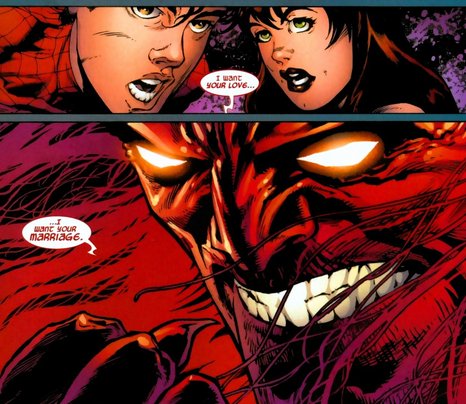
Ok, I've been building up to it, let me finish by slamming the lack of understanding of how to write characters well home. One More Day.

Half the people reading this shuddered, and the rest will understand why in a few moments.

So, for those who don't follow comics, let's talk about Spider-Man shall we? He's a beloved character, arguably Marvel's most famous creation, and has a very successful film franchise. For those not familiar with the comics, Spider-Man, well, Peter Parker, and Mary Jane have been married in the comics for quite some time. Or, I suppose, were. They were married. Because Spider-Man sold his marriage to THE DEVIL.


Couldn't make this stuff up if I tried folks.

Yeah. One More Day was a 2007 four part comic event where, I say it again for emphasis, Spider-Man sold his marriage to the devil.

Well, technically the demon Mephisto but let's not argue semantics. If it looks like a duck, sounds like a duck, and weighs the same as a duck, it's a witch, and should probably be burned.

Now I'll admit I haven't read it myself, but the plot synopsis and fan reaction is enough for me to be nursing a headache just thinking about it. Short version is this: Aunt May is shot and killed by a bullet intended for Spider-Man. Spider-Man, feeling guilty and as though her death was his fault decides to find a way to bring her back, instead of coping with her death like a normal person. So he talks to Mephisto who says that Spider-Man is soooo happy that it disgusts him and if he sells his marriage he will bring Aunt May back to life. And Spider-Man agrees.

If you really need to understand why this is monumentally stupid, watch the following video by Linkara of Atop the Fourth Wall.


...Yeah. Not Spidey's finest moment.

Wednesday, July 6, 2011

The Problem With Bioshock 2 (And Why I'm Cautious About Bioshock Infinite)

So this isn't going to be a proper review because I'll be honest: I haven't beaten Bioshock 2. I got what I think is about halfway through the game, and I just stopped playing. In fact, I only recently finished playing the original Bioshock.

Now, the original Bioshock is a great game. It had some issues, but is remembered for a fantastic, absolutely phenomenal ending that was really a deconstruction of the nature of games themselves, and then continuing for about three more hours of crap, because having an unhappy ending would be bad. Alternatively, if you're the kind of twitch-reflex Call of Duty fanboy who doesn't care about a fascinating deconstruction of the very nature of games themselves, it had Big Daddies.


The game took place on one of the best settings ever in video gaming, the city of Rapture, an underwater utopia turned underwater distopia. It contained a lot of interesting aspects, and entire discussions could be had about the first game alone, and have been. Is it a cautionary tale of the need for morals? Is it a warning that man should not play God? Is it just a haunting tale of an underwater city? Would the city have been doomed without the discovery of Adam, or was Adam itself what led to the downfall? Interesting conversations could be had about any of these.

In addition, the game had good, albeit perhaps not great, gameplay. Except the hacking, that sucked. But the introduction of Plasmids, which could essentially rewrite the human body to do anything led to some interesting mechanics. My favorite, although not the most useful, was the one that let you shoot bees at people.

So why would a sequel to this beloved game be bad? Well there's a few reasons. First of all, Rapture as a set piece was more effective as you explored and learned about the history of the city. It was a brilliant example of how games can be art, and how games can offer a different storytelling experience than a film can. Once you already know the history of the city, it loses a lot of effect. While the city is still beautiful and haunting, you've already experienced it, and it becomes a more familiar place. One of the greatest things about discovering Rapture is just how alien it is, just like the oceans below us can, at times, seem alien.

In addition to this, the story of Bioshock was rapped up beautifully in Bioshock. And then the game decided to keep going for about three hours- Ok, sorry, that's not what this is about and if I talk about why the game should have ended at the big "Would you kindly" scene, this post will be about something different. The point is, Bioshock had a great story. That story was told in Bioshock.

So a sequel to Bioshock was always going to be tricky, they ran the risk of shoving another tale into a setting that had already been explored. And in truth, that's exactly what they did. While the story in Bioshock 2 isn't bad, per say, nothing carries the same emotional, or philosophical weight. For one thing, this one paints the church in a negative light. Now, I could tolerate that, except it kind of goes against everything the first one was about. Now, I don't claim Bioshock had some sort of religious message, that would be foolish, but one possible interpretation, in fact something that's essentially said within the game, is that a society where every man fends only for himself and not for some form of greater good, is doomed to fail. Say what you will about religion, it's all about serving a higher power and doing the correct moral thing.

In addition to this, the characters introduced in Bioshock 2 (or what I've played of it) all seemed forced into the setting. Rapture had fallen, and almost everyone was dead by the beginning of Bioshock, and the survivors had turned the city into a warzone. With Bioshock 2 taking place ten years later, I find it hard to believe that the splicers would have survived another ten years fighting and killing each other constantly in a city that was falling apart. Plus, all the new characters seemed forgettable. I remember the characters from Bioshock one, even the minor ones. The deranged surgeon who likened himself to Picasso. The artist who had you hunt down and kill certain individuals on Rapture to use pictures of their corpses in his sickening art gallery. These characters are haunting, and sickening, and stay with you long after. I don't think any of the characters in Bioshock 2 had any of the same weight.

Now, the game isn't all bad. In fact, in pretty much every gameplay aspect, it's an improvement. The guns are all bigger and better and actually pretty fun to use, and the ability to have both a plasmid and a gun out at the same time is huge. But in a way, the guns are very telling of one of the games faults. Bigger and better syndrome. It just had to be bigger and better. Instead of a submachine gun, you get a machine gun. Instead of a pistol, you get a rivet gun. Instead of a wrench, you get a giant drill.

But none of these things are Bioshock 2's main problem. Bioshock 2's main problem is the protagonist, Alpha.

One of the most memorable aspects of Bioshock was the Big Daddies. The Big Daddies were giant monsters who usually wouldn't attack unless provoked, who guided the Little Sisters around Rapture as they collected Adam from the many dead bodies. They were scary. They felt big and heavy, with giant diving helmets, making loud noise and shaking the very ground as they walked near. You couldn't reason with one, you had no idea what they were thinking, they couldn't speak, only make bizarre grunts, and they didn't seem human. They felt more like an extension of the city itself. Not human, not even really beasts. You didn't have any idea what was going through their heads, if they could even think. They were one of the aspects that made Rapture seem the most alien.

Then Bioshock 2 made you one.

Suddenly, they lost all that effect. They felt human. If you were one of them, albeit a prototype one, then they were just as reasonable as you. Sure, for all intents and purpose they function the same as they do in the first game, but they feel different, knowing they can be reasonable. They aren't the same force of nature they were in the first game, they're just people. In a way, perhaps some may find that more disturbing, but they weren't really disturbing in the first game, just alien. The Little Sisters, now those were disturbing in the first game, but the Big Daddies? Not really.

Now, admittedly I haven't gotten far enough into the game to know what the Big Sisters are exactly (though I have my suspicions), but they aren't really scary either. Sure, they're deadly, but if the Big Daddies are just people they lose a lot of effect, and the Big Sisters probably are as well.

I mean, we knew from the first game Big Daddies were once humans, but I assumed they underwent some sort of brainwashing- In fact, I'm fairly sure there were audio logs confirming that they did.

Now then. I've said my piece on Bioshock 2, let's talk about Bioshock Infinite.

Ok, Bioshock Infinite, for those not in the know, is the new Bioshock game. It's a Gaiden Game in every sense. Now, let me start off here by saying I am cautiously optimistic about Bioshock Infinite. I'm not completely sold on the game yet, for reasons I'll go into in a moment, but it does have a really cool setting, art style, and it looks like it does some very cool things.

The game is going to take place on the floating city of Columbia. It's set about 30 years earlier than Bioshock, and it has nothing to do with Rapture, other than that apparently Rapture will someday be built in this universe. Columbia was built as a wonder of the world by the U.S.A., before it went rogue and started a war with China or Russia or something, at which point the U.S. denied any affiliation with it, saying it had gone rogue. Since then, Columbia has become a sort of bogeyman, floating around and attacking cities, hard to destroy with the technology of 1910, but very strong itself.

The setting is very steampunk, and the game looks cool aesthetically. It contains "Tonics" instead of "Plasmids" and features time manipulation as a main mechanic. The main character, as opposed to Bioshock or Bioshock 2, is not a silent protagonist, but a man fighting to survive on Columbia which seems to be experiencing a Rapture-style fall.

Now at first you might say, "Hey! Why wouldn't you love this to death? The game looks awesome and it addresses all the complaints you raised about the first game, even introducing new psuedo-cyborgs called Handymen instead of Big Daddies! The new setting will provide you a new interesting locale to explore, and a new story to enjoy featuring what seem like two great new characters named Booker DeWitt, a name that sounds like it came out of a 1940's detective serial, and Elizabeth, a name which is a name." To which I would, naturally, reply "Right you are theoretical yet very well informed person who is addressing my skepticism of the game. Now would you kindly tell me why the game is called Bioshock?"

It takes place years before Rapture was built, has nothing to do with any of the characters from Bioshock or Bioshock 2, takes place in the sky instead of in the ocean, features new villains, monsters, powers, characters, and gameplay mechanics, and according to some inside sources may even TAKE PLACE OUTSIDE THE BIOSHOCK TIMELINE ENTIRELY. WHY IS THIS NOT A NEW FRANCHISE CALLED COLUMBIA? I mean sure, I'd be calling it a Bioshock clone if it were a new franchise entirely, but there's nothing wrong with being a Bioshock clone! Some of my best friends are Bioshock clones, although admittedly they have the advantage of containing Batman. (Note: That's not quite fair, Arkham Asylum is more like Splinter Cell with a Bioshock skin pasted on, and then a Batman paint job.)

The idea of a Bioshock like game taking place in a steampunk city in the skies isn't a bad one at all. In fact, like I said, the game looks gorgeous. There's like a robot dragon on a giant floating city, for crying out loud, how can that not be cool? But it just doesn't seem like this game has anything to do with Bioshock itself.


I really do think Bioshock Infinite looks like a lot of fun, and they are doing some interesting things with the mechanics, like having Elizabeth be with you the whole time, mind you if they mess that up at all this game will be awful, and we all know how easy it is to mess up escort missions since there hasn't been a good escort mission in the history of gaming. Ok, Half-Life 2's Episodes, but being put up next to a Valve game for comparison means you have some pretty big shoes to fill!

There's nothing wrong with Gaiden Games (games which, though set in the universe of one game, are their own stories with little interaction outside of reference to the main series), I mean fans of this blog will know how big a fan of Portal I am, and that's a Gaiden Game to Half-Life, but the best Gaiden Games feature new settings that fit in flawlessly to the main universe. I have no difficulty believing Aperture Labs exist within the world of Half-Life, nor that the Combine were kept out by GLaDOS. I have no problem accepting it when Cave Johnson rants about Black Mesa stealing Aperture's experiments. But part of the point of Bioshock was that it seemed like the world outside Rapture was just like our own, with the exception of, well, Rapture existing. If Columbia existed and these Tonics which rewrote your genome already existed, why was finding Adam and creating Plasmids a big deal in the first place? And if it's true that this doesn't even take place in the same universe as Bioshock, then I ask again, why is it called "Bioshock" Infinite? It seems like a cash in to me, that's all.

This would quite possibly be the game I'm look forward to the most if I didn't have a feeling of dread that Infinite is simply going to be either another game that retcons the original Bioshock in a way which quite simply makes it less good, or it's going to be something completely different that shoves in a cameo from the main Bioshock world using the time manipulation powers. Seriously, I wouldn't be surprised at all, since we already know that at certain points Booker and Elizabeth get pulled through portals to different time periods like the 1980's, if at one point you get pulled onto Rapture for five minutes, fight a Big Daddy, and then get flung back to Columbia and act like nothing happened.

I wouldn't be surprised, but that's not to say I wouldn't be angry.

Saturday, June 18, 2011

Movie Review - Mr. Popper's Penguins


I'm just going to start the review off with this; I know Jim Carrey is a very polarizing actor. You either love him, or you hate him. Personally, I'm of the camp that loves him. My third favorite film (behind The Dark Knight and The Nightmare Before Christmas) is The Truman Show. I love Liar Liar, Bruce Almighty, The Mask, The Majestic, and I even find his less enjoyable films like Yes Man enjoyable. Heck, I even liked him in the awful film adaptation of A Series of Unfortunate Events, though honestly it was a poor choice to cast him in that role along with many other poor choices made in that film.

So basically what I'm saying is that I'm a fan of Jim Carrey. He's probably in my top five favorite actors for The Truman Show and The Majestic alone. I know he overacts and plays up the slapstick humor, and I honestly wish he'd make more dramatic films, but he's Jim Carrey, and I just can't make myself dislike him.

So, now that I've spoken about the leading man, let's talk about the movie, shall we? Mr. Popper's Penguins is- Ok, let's stop right here. You know exactly what this movie is already. It's a Jim Carrey movie!

The movie begins with Mr. Popper, played by Jim Carrey, obviously, being the dad from Liar Liar. Over the course of the film, Bruce gains the mystical powers of Morgan Freeman, and proceeds to use them to create wacky hijinks involving a mystical mask that calls upon the powers of Count Olaf to bring shame to a popular series of surprisingly well written and hilarious books.

Ok, seriously, I'll stop. Jim Carrey starts off the film as a divorced businessman with two kids who can't stand him. Then through the magical powers of plot convenience, Jim Carrey ends up with 6 CGI penguins who do various adorable things throughout the movie. Except for all those stupid toilet jokes. Those aren't funny or adorable.

I actually enjoyed this film quite a lot, but like I said, I like Jim Carrey. If you're a fan of Jim Carrey, like I am, you'll probably find something to enjoy in this movie. He's slapstick, over the top, and as much like a real-life cartoon character as any comedic Jim Carrey role. He's good in it, but make no mistake, he is being Jim Carrey. If you do not like Jim Carrey, you will not like this film.

What I didn't expect is that there were actually several things in this movie I liked outside of Carrey. In fact, my favorite gag in the entire film is his assistant Pipi, who proclaims perilously p-filled prose about Popper and his preposterously perfect penguins. My favorite moment in the entire film involves her in the last few minutes.

The penguins themselves actually look really nice. You can tell they're CGI, but they're very nice looking CGI. The acting from the entire cast ranges from good (Madeline Carroll, his daughter, who is also in another film I'm quite fond of, Swing Vote) to passable (his son, Maxwell Perry Cotton, seems a bit stale at times) and there are some gags that actually had me laughing pretty hard. Oh! Also the S.H.I.E.L.D. agent from the Marvel movies is in this film. And he's great in it, but only because I kept thinking of him as the same character, and that the job as a zookeeper he has in this film is just what he does on weekends.

I also thought the wardrobe for Jim Carrey, having him wear a tux for a large portion of the film, was a nice touch.

But let's talk about what I didn't like about the film as well. It's a kids film, and while it's a very well done kids film, there's nothing here you haven't seen before. A lot of the charm in this movie comes from the penguins, but of course it requires a LOT of suspension of disbelief for any of the penguin's gags to actually register. Not to mention the idea that a guy could just keep penguins in his apartment and not get caught.

Jim Carrey also attempts to coin yet another catchphrase here, "Yeahbsolutely." It's exactly as irritating as you might imagine.

I'm actually going to get a bit spoilery here to talk about the films biggest flaw, so if you really think this film is going to contain any surprises for you, skip the next paragraph.

About 2/3rds of the way into the film a disaster strikes the penguins. Mr. Popper tries his hardest to protect them, to the point where he obviously sacrifices not only his job, and his status, but quite clearly his health. Unable to prevent disaster, Mr. Popper doubts his ability to take care of the penguins. Thus, he gives them to the zoo where they will actually be taken care of. He honestly thinks he's doing the right thing, and to me it came across as a really heartfelt scene. The movie then makes it apparent that we're supposed to be disappointed in him for this. Sorry, but no.

Alright, no more spoilers.

Other than that one major flaw, the film is enjoyable. If you like Jim Carrey, you'll find this enjoyable at the very least. If you don't, you'll probably want to steer clear of Mr. Popper, and his penguins.

Wednesday, May 25, 2011

Video Game Review - Assassin's Creed: Brotherhood


Readers of my blog will remember my reviews of Assassin's Creed, and Assassin's Creed 2. In short, Assassin's Creed is a game worth playing, despite many flaws, and Assassin's Creed 2 is a game that, while probably a better game objectively (all the systems worked better in AC2) it was, to me at least, a less enjoyable experience. Still a game worth playing though. Also, it had a brilliant ending.

Now, folks, let me tell you, it is time for much rejoicing, for while Assassin's Creed and Assassin's Creed 2 were both sort-of-good games, Assassin's Creed: Brotherhood is a GREAT game. This is by far the best Assassin's Creed experience thus far, and it blows the other two out of the water.

Assassin's Creed: Brotherhood is sort of an "Assassin's Creed 2.5" if you will. It picks up directly where the second game left off, and honestly, if you don't play it you WILL be confused jumping into the inevitable Assassin's Creed 3. It puts you, once again, back in the shoes of Ezio Auditore da Firenze, the renaissance assassin who you were put in the shoes of in Assassin's Creed 2. The game literally begins exactly where the second game left off, with Ezio *spoilers for the ending of AC2* walking out of the vault, bewildered by the mysterious message left for Desmond. Victorious over the pope however, he goes back to his home, and relaxes in a segment where you help the various townspeople with mundane problems.

And then, it naturally all goes wrong. He is renaissance Batman, after all.

In short, the son of the pope who you DIDN'T murder at the end of AC2 (which was dumb, Ezio has no problem killing hundreds of guards who likely just work to feed themselves and their families, but finally when he meets the evil pope he doesn't kill him? What?! Bah, I digress, that's a problem with the second game, not this one.) Cesare Borgia, blows up the city, and takes the Apple of Eden from you.

Cue going back to Desmond, and finding out the reason why you're still reliving Ezio's memories, to find out where exactly the Apple of Eden ended up. Of course to do that you have to relive the memories leading UP to that point because if you don't the polarity of the power couplings could be reversed causing a temporal anomaly which would leak vast quantities of wibbly-wobbly-timey-wimey radiation into the stargates which would then... You get the idea. It's a cheap excuse why we're playing a full game not just 15 minutes of one, but it works nonetheless.

The plot of this game, like most aspects of this game, is FAR superior to the other two. You'll remember one of my main complaints about AC2 was that you didn't become an Assassin until the last hour or so of the game. In this, you're already an Assassin at the beginning, and it shows.

However, another problem I had with the story of the second game was that it was CONFUSING! Half the time I didn't understand how the people I was killing were related to the overarching conspiracy, and was really just killing them because the mission told me to.

This game however, has a central story with definite first, second, and third acts. It has one central villain (Cesare), and it's coherent. Whereas the second game lacked any kind of focus and just felt as though the story were aimlessly wandering, Brotherhood has a story that pulls you in, and keeps you interested.

That said, Assassin's Creed is becoming my new Lost. Each game thus far has had an infuriating cliffhanger ending that leaves you scratching your head going "What just happened?!"

In any case, the game plays almost identically to Assassin's Creed 2, but every aspect of it has been polished to the point of near perfection. The combat is actually entertaining, the missions are tons more fun due to a new system of bonus objectives you don't HAVE to complete. For example, some missions have you get into a heavily guarded area, but the bonus objective is to do it without killing anyone.

The result is the perfect balance between being a stealth game, like Assassin's Creed SHOULD be, and still allowing you to muscle your way through large portions of it, like in AC2.

There are also loads of optional missions in this game, similarly to AC2, but they don't suck this time. There are Courtesan missions which follow their own storyline, missions to kill Templars, and missions reliving the past, introducing you to Ezio's first love Cristina.

The biggest change to the single player game though is a system where you rescue citizens and then teach them to become assassins, who can help you in combat, or go on missions of their own to get you money, among other things. As you teach them they gain levels and become more powerful, before finally become Assassin's themselves.

Overall, the game is a blast to play, and is definitely better in every way than the past two installments. It's the game the first Assassin's Creed should have been.

However, the biggest new addition to the series is multiplayer. In the multiplayer, you play templars who are in a training programs to learn to be assassins.

The object of the multiplayer is to assassinate your assigned target, while being pursued yourself by someone else. Assassinations earn you points, and the person with the most points after 10 minutes wins. However, the map is populated with NPC's who look like each of the players, and thus you have to learn to act like an NPC to fool other players into thinking you're an NPC, while figuring out (given only their general location via a compass) which one of the many people who look like your target are actually your target.

The multiplayer is a LOT of fun to play, although it seems nearly impossible to find a game anymore, due to lots of players having quite playing by now. It takes a good 5-10 minutes sometimes.

Buy this game if: You enjoyed the first two Assassin's Creed, or thought there was potential for a good game in them.

Don't buy this game if:
You really didn't think there was any way you could have liked the first two Assassin's Creeds.